
Every dish we serve on a Barcelona Born & Bred food tour has a reason to be there. Not because it photographs well, and not because tourists expect it — but because it tells you something true about how this city eats. Some of these you'll recognise. Others you've almost certainly never tried. Here's what's waiting for you.
The Tapas
Pa amb tomàquet — the one that starts everything
Bread rubbed with ripe tomato, a drizzle of olive oil, a pinch of salt. That's it. And yet no Catalan table is complete without it.
What most visitors don't know is that it began as a way to rescue stale bread — rub it with tomato and it softens back to life. A peasant trick that became the single most Catalan thing you can eat. Order it anywhere in this city and you'll be handed the same four ingredients, and it will taste different every time.
Where you'll try it: Tapas & Wine Tour
La bomba — Barceloneta's edible grenade
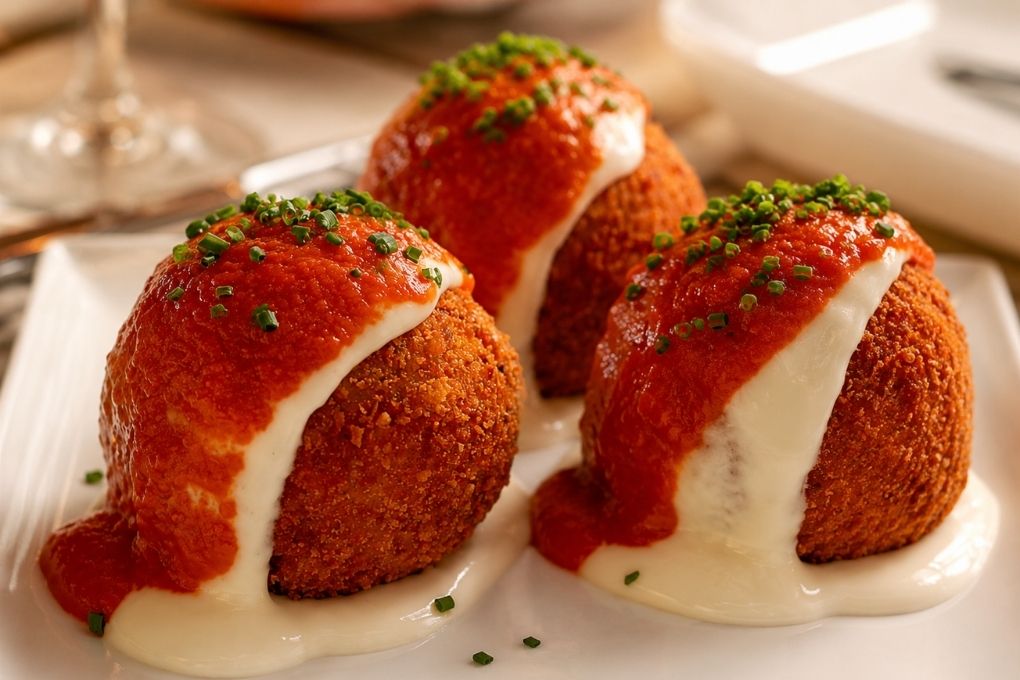
A ball of potato and meat, breaded, fried, and topped with two sauces: one garlicky, one spicy. It was invented in Barceloneta in the 1950s, and the name is no accident — the round shape, the sauces running down the sides like a lit fuse.
It's messy. It's rich. It's the tapa people talk about weeks after the tour.
Where you'll try it: Tapas & Wine Tour
Patates braves — and why yours have probably been wrong
Fried potato, brava sauce. Simple. But here's the thing most bars outside Spain get wrong: braves means fierce, and the sauce is supposed to have heat. Not ketchup with a splash of paprika. Not aioli dumped on top as an afterthought.
A good brava sauce is smoky, sharp and genuinely hot. When you have the real version, you understand why people here get so protective about it.
Where you'll try them: Tapas & Wine Tour
Croquetes — the test of a good kitchen
Béchamel, breadcrumbed and fried until the shell shatters and the inside runs almost liquid. Simple in theory, brutally hard in practice: too firm and it's stodgy, too loose and it collapses in the fryer.
Ask any Catalan and they'll tell you a bar's croquetes tell you everything you need to know about the kitchen behind it. Ours come from places that have been getting it right for decades.
Where you'll try them: Tapas & Wine Tour
If you want to understand how these dishes fit into a real evening route, read our guide to what to expect on a Barcelona tapas tour.
Truita — the Spanish omelette, done the local way
Egg and potato, slow-cooked until the outside is set and the centre still gives. The eternal argument here is whether it should have onion. Half the country says yes, the other half considers it heresy.
Whichever side you land on, a good truita is one of the most comforting things you can eat standing at a bar with a glass in your other hand.
Where you'll try it: Tapas & Wine Tour
Escalivada — smoke, patience and vegetables
Peppers, aubergines and onions roasted slowly over embers until the skins blacken, then peeled and dressed with good olive oil. The name comes from the Catalan verb escalivar: to cook in ashes.
It's proof that Catalan cooking doesn't need meat to be serious. Sweet, smoky, silky. Most visitors are surprised by how much they want a second plate.
Where you'll try it: Tapas & Wine Tour
Gilda — the pintxo with a sharp tongue
An olive, a pickled guindilla pepper and an anchovy, skewered together. Three ingredients, one bite, and a jolt of salt, acid and heat all at once.
It's named after the 1946 Rita Hayworth film. The story goes that regulars at a San Sebastián bar decided the pintxo was verde, salada y un poco picante — green, salty and a little spicy — just like the character. The name stuck.
Where you'll try it: Tapas & Wine Tour
Hungry already? These are all on the same tour.
See the Tapas & Wine TourFrom the Sea, the Mountain and the Cellar
Pernil ibèric and pernil serrà — and the difference nobody explains
Two cured hams, two completely different animals. Pernil ibèric comes from black Iberian pigs that roam oak forests eating acorns — the fat marbles through the meat, and the flavour is nutty, deep and faintly sweet. Pernil serrà comes from white pigs, cured in the mountain air, leaner and saltier.
Both are excellent. They are not the same thing, and any bar that pretends otherwise is not a bar you want to be in. On the tour you'll taste them side by side and finally understand what you've been paying for.
Where you'll try them: Tapas & Wine Tour
Mojama — the Mediterranean's cured tuna
Tuna loin, salted and air-dried until it turns dense and deep red, then sliced paper-thin with a little olive oil and maybe some almonds. The Phoenicians were doing this three thousand years ago on these same coasts.
It tastes like the sea concentrated into something you can hold. Most visitors have never heard of it. Almost all of them ask where to buy some before the tour ends.
Where you'll try it: Tapas & Wine Tour
Peixet fregit — small fish, fried properly
Little fish, floured and fried fast in hot oil so they stay crisp outside and tender within. Eaten whole, with your fingers, with a squeeze of lemon.
It's the most Mediterranean thing on the table — the kind of food that only exists in cities that have always looked out to sea.
Where you'll try it: Tapas & Wine Tour
Formatges locals — Catalan cheeses you won't find at home
Catalonia makes serious cheese, and almost none of it leaves the region. Goat, sheep and cow, from small producers in the Pyrenees and inland valleys — some fresh and mild, some aged and sharp enough to stand up to a red from Montsant.
This is one of the parts of the tour where people go quiet for a moment, and then ask for the name of the producer.
Where you'll try them: Tapas & Wine Tour
Olives — never just olives
Arbequina from Catalonia, small and buttery. Gordal, fat and meaty. Cured with herbs, with garlic, with a strip of orange peel. In Spain an olive is not a garnish — it's the thing you eat while you decide what else to order, and it sets the tone for everything after it.
Where you'll try them: Tapas & Wine Tour
What You'll Drink
Vermut de Reus — the ritual, not the drink
Reus, an hour south of Barcelona, is the historic capital of Catalan vermouth. Sweet, red, herbal, served over ice with an olive and a slice of orange.
But fer el vermut ("doing the vermouth") isn't really about the alcohol. It's about standing at a bar around midday, glass in hand, talking to whoever's next to you. It happens on Sundays before lunch as reliably as the sun comes up.
Where you'll try it: Tapas & Wine Tour
Cava — and why it isn't "Spanish champagne"
Made in the Penedès, a short drive from Barcelona, using the same traditional method as Champagne but with local grapes: macabeu, xarel·lo, parellada. Crisp, dry, faintly nutty.
Catalans don't save it for celebrations. It's a Tuesday drink. Order it at a bar at seven in the evening and nobody will think twice.
Where you'll try it: Tapas & Wine Tour
Young white from the Penedès
The same region that gives us cava also makes bright, fresh young whites — mineral, citric, built for seafood and for the heat. Perfect against the mojama and the fried fish.
Where you'll try it: Tapas & Wine Tour
Red from Montsant — the region in Priorat's shadow
Montsant wraps almost entirely around Priorat, shares much of its slate soil, and produces reds of real depth and structure — for a fraction of the price. Ask any sommelier in Barcelona where the value is, and they'll say Montsant.
Full-bodied, with dark fruit and a mineral backbone. This is the one that stands up to the aged cheeses and the ibèric.
Where you'll try it: Tapas & Wine Tour
Craft beer from Barcelona's oldest microbrewery
Barcelona has a serious craft beer scene, and Gràcia is at the heart of it. On the Beer & Castellers Tour you'll drink where locals drink — before heading somewhere no other food tour in the city will take you.
Where you'll try it: Beer & Castellers Tour
The Fork Breakfast — the meal almost no visitor tries
This is the part of Catalan food culture that even seasoned travellers miss entirely.
The esmorzar de forquilla — literally "fork breakfast" — is a full, hot, hearty meal eaten mid-morning, with a knife and fork, traditionally by labourers who'd been working since dawn. It is not toast. It is not a pastry. It is stew, at ten in the morning, with wine.
It survives in a handful of neighbourhood restaurants, and it is one of the last genuinely working-class food traditions left in the city. Depending on the day and the season, your plate might hold slow-cooked snails, tripe stew with chickpeas, salt cod with garlic and potatoes, or pork feet falling off the bone.
Whatever it is, it will be hot, generous and utterly unlike any breakfast you've had before.
Ready to eat breakfast the way Barcelona actually does?
See the Market TourWhich Tour Should You Choose?
It depends what you're after.
- Want the classics — tapas, hams, cheeses, cava and Catalan wine? The Tapas & Wine Tour through El Born and the Gothic Quarter.
- Want the food no visitor tries? The Market & Fork Breakfast Tour at Sant Antoni — stew at ten in the morning, exactly as Barcelona has done it for a hundred years.
- Want something no other tour offers? The Beer & Castellers Tour — craft beer in Gràcia, then inside a live human tower rehearsal.
All three are small groups, capped at ten people, led by guides who were born and raised in this city. If you're still deciding, our guide to choosing the best food tour in Barcelona walks you through it.
FAQ: What You'll Eat on a Barcelona Food Tour
It depends on the tour. The Tapas & Wine Tour includes pa amb tomàquet, la bomba, patates braves, croquetes, truita, escalivada, gilda, mojama, fried fish, local Catalan cheeses, olives and both pernil ibèric and pernil serrà — paired with cava, vermut de Reus, a young white from the Penedès and a red from Montsant. The Market & Fork Breakfast Tour includes a traditional esmorzar de forquilla. The Beer & Castellers Tour includes craft beer and traditional snacks.
Pernil ibèric comes from black Iberian pigs raised on acorns in oak forests — the fat marbles through the meat and the flavour is nutty and deep. Pernil serrà comes from white pigs and is cured in mountain air, producing a leaner, saltier ham. Both are excellent, but they are entirely different products.
Pa amb tomàquet is bread rubbed with ripe tomato, drizzled with olive oil and sprinkled with salt. It began as a way to soften stale bread and became the most emblematic dish in Catalan cuisine. It accompanies almost every meal in Barcelona.
Mojama is tuna loin that has been salted and air-dried until dense and deep red, then sliced paper-thin and served with olive oil. It's one of the oldest preserved foods in the Mediterranean, dating back to the Phoenicians, and remains a delicacy along the Spanish coast.
On the Tapas & Wine Tour you'll taste cava from the Penedès, a young white also from the Penedès, and a red from Montsant — the region that surrounds Priorat and offers remarkable quality for the price. You'll also try vermut de Reus, the historic capital of Catalan vermouth.
Yes. We accommodate vegetarians and most dietary restrictions with advance notice — dishes like pa amb tomàquet, escalivada, patates braves, truita, local cheeses and olives are already vegetarian. Just let us know when you book and we'll adapt the experience for you.
Yes. All our tours include enough food to work as a full meal — most guests finish comfortably full. Come hungry.
Come hungry. Leave with a list.
Three tours. Small groups. Guides who grew up eating all of this.
Compare our food tours