

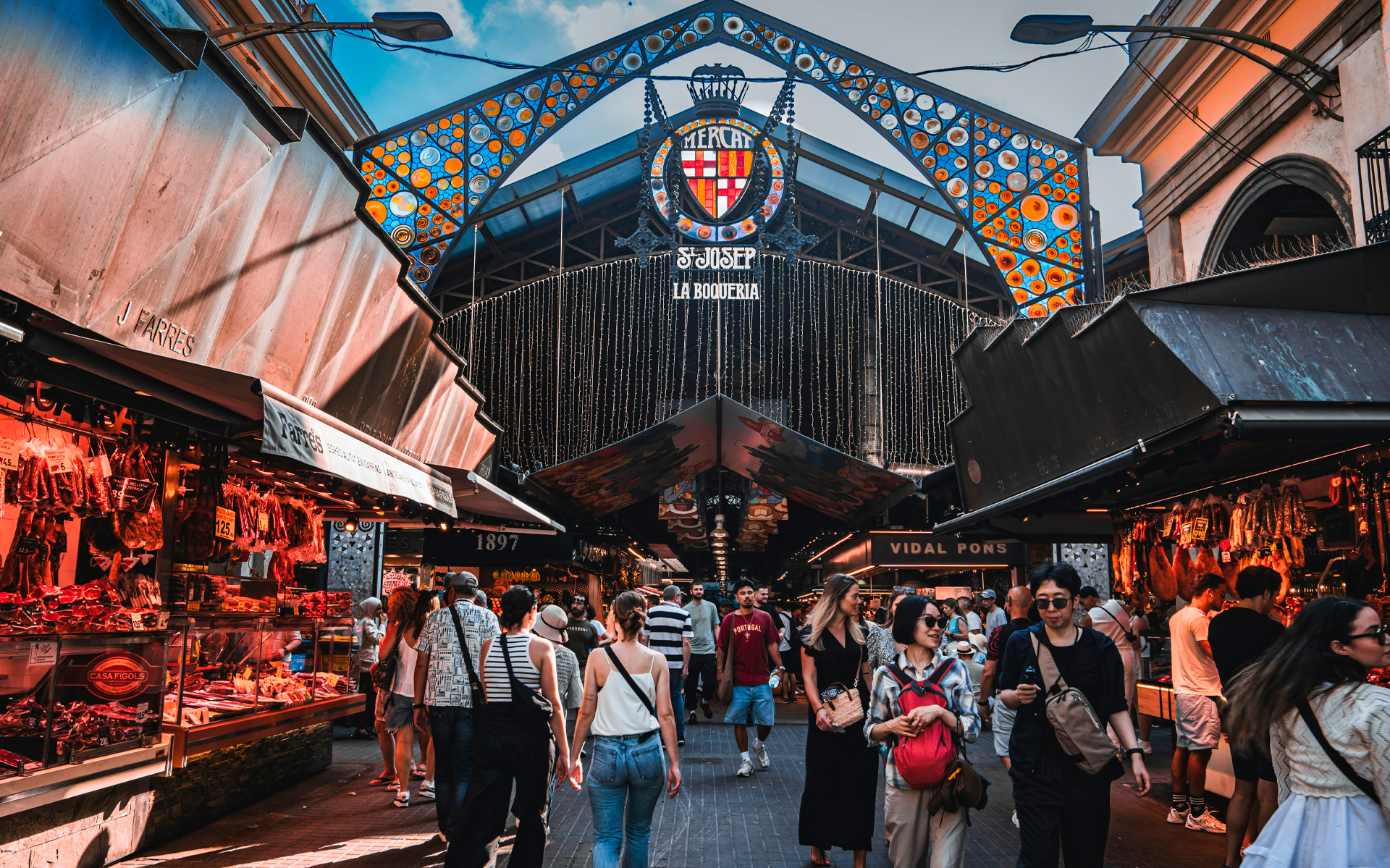
Barcelona has a market in almost every neighbourhood, and visiting one is one of the easiest ways to understand how the city actually eats.
Some markets have become internationally famous. Others still feel very closely connected to the people who live around them. You'll find fishmongers, butchers, fruit and vegetable stalls, charcuterie, olives, conserves, bakeries and bars serving breakfast or lunch only a few metres from the ingredients they use.
If you only know La Boqueria, you're seeing just one version of Barcelona's market culture.
This guide compares six of the best food markets in Barcelona and explains which one to visit depending on your neighbourhood, interests and the kind of experience you're looking for.
Quick answer: La Boqueria is the easiest market to visit on a first trip. Santa Caterina works particularly well when exploring El Born and the historic centre. Sant Antoni is our choice for travellers interested in everyday Catalan food culture. El Ninot and La Concepció are excellent Eixample markets, while La Llibertat is the natural choice if you're spending time in Gràcia.
Which Barcelona Food Market Should You Visit?
1. La Boqueria — Barcelona's Most Famous Food Market
Officially called Mercat de Sant Josep de la Boqueria, La Boqueria is Barcelona's best-known food market and one of the city's most visited places.
Its history stretches back centuries, although the present market developed on the site of the former Sant Josep convent and eventually received its famous iron and glass roof in the early twentieth century.
Inside you'll find fruit and vegetables, fish and seafood, meat, charcuterie, olives, conserves, nuts, dried fruit and specialist stalls alongside market bars and places serving prepared food.
La Boqueria is worth seeing, but its location directly on La Rambla means that it receives far more visitors than most Barcelona neighbourhood markets.
2. Mercat de Santa Caterina — Best Market Near El Born
Santa Caterina is only a short walk from Barcelona Cathedral and El Born, making it one of the easiest markets to combine with sightseeing in the historic centre.
The market is immediately recognisable because of its colourful undulating roof, created during the renovation led by architects Enric Miralles and Benedetta Tagliabue.
Santa Caterina was Barcelona's first covered market, built on the site of the former Dominican convent that gave the market its name.
Inside, it remains a working municipal market with fresh food stalls, while its location makes it particularly useful if you're exploring El Born but want a different market experience from La Boqueria.
If you're planning to spend more time in the neighbourhood, continue with our local guide to El Born .
3. Mercat de Sant Antoni — Best for Local Catalan Food Culture
If food is one of the main reasons you're visiting Barcelona, Mercat de Sant Antoni deserves more attention than it usually receives from first-time visitors.
The huge iron market building occupies an entire city block and combines several traditions under one roof: the fresh food market, non-food commerce and the famous Sunday books and collectors' market.
The current building dates from the nineteenth century and reopened in 2018 after a major renovation.
What makes Sant Antoni particularly interesting is the relationship between the market and the neighbourhood around it. You can visit the food stalls and then continue into streets filled with bakeries, cafés, vermut bars and restaurants.
It is also a good place to understand the Catalan tradition of the esmorzar de forquilla — a substantial knife-and-fork breakfast built around cooked dishes rather than pastries.
We have a complete guide dedicated to the market: Sant Antoni Market Barcelona .
Explore Sant Antoni With a Local Guide
Our Sant Antoni Market & Fork Breakfast Tour combines the market with local products, neighbourhood stories and a traditional Catalan breakfast.
Discover the Sant Antoni Market Tour4. Mercat del Ninot — One of Eixample's Best Food Markets
Mercat del Ninot is one of the most useful markets if you're staying in Eixample.
The market building was inaugurated in 1933 and later underwent a major renovation. Today it combines traditional fresh-food stalls with bars, prepared food and other services.
It receives far fewer sightseeing visitors than La Boqueria, so the atmosphere is much closer to that of an everyday neighbourhood market.
Look at the fish counters, butchers, charcuterie and seasonal produce before deciding what to eat elsewhere in the city. Barcelona's municipal markets can be useful simply as a way of understanding what ingredients are being used at that time of year.
5. Mercat de la Llibertat — The Food Market of Gràcia
Mercat de la Llibertat sits right in the heart of Gràcia and has been part of the neighbourhood since the nineteenth century.
The market opened in 1888 and still offers the classic mix of a Barcelona municipal food market: fish and seafood, meat, charcuterie, fruit and vegetables, legumes, bread, conserves and other everyday products.
Its biggest advantage for a visitor is location. Gràcia is one of Barcelona's best areas for wandering without a strict plan, and the market fits naturally into a morning exploring the neighbourhood's squares and smaller streets.
If you're already planning to spend time in Gràcia, there is little reason to cross the city just to visit a more famous market.
6. Mercat de la Concepció — Food and Flowers in Eixample
Mercat de la Concepció is another strong option for travellers staying in Eixample, particularly around Passeig de Gràcia and the streets east of it.
Alongside the food market, La Concepció is closely associated with flower shops, giving it a slightly different identity from Barcelona's other municipal markets.
It is convenient, central and useful if you want to see a real neighbourhood market without building an entire morning around the visit.
This is one of the main lessons of Barcelona's markets: the best one is often simply the good market closest to where you're already exploring.
Barcelona Food Markets Compared
| Market | Neighbourhood | Best for | Our take |
|---|---|---|---|
| La Boqueria | Raval / La Rambla | First visits | The most famous and varied, but also the busiest. |
| Santa Caterina | Historic centre | El Born | Excellent combination of food, location and architecture. |
| Sant Antoni | Sant Antoni | Local food culture | Our choice for travellers who want more context around Catalan food. |
| El Ninot | Eixample | Fresh food | A strong neighbourhood market with fewer sightseeing visitors. |
| La Llibertat | Gràcia | Neighbourhood life | The obvious market to combine with a day in Gràcia. |
| La Concepció | Eixample | Food + flowers | Central, convenient and easy to include in an Eixample walk. |
What Should You Eat at a Barcelona Food Market?
Barcelona's markets are primarily places to buy ingredients, not giant food halls designed around prepared dishes.
That distinction matters. Some markets have excellent bars and places to eat, but visiting a market is just as much about understanding the ingredients behind Catalan cooking.
For a broader introduction to local dishes, see our guide to what to eat in Barcelona .
When Is the Best Time to Visit Barcelona's Food Markets?
In general, morning is the best time.
The stalls are fully active, fresh produce is on display and you'll see more of the market's everyday rhythm. It also makes it easier to combine a market visit with breakfast or lunch.
If you're visiting La Boqueria, going earlier is particularly useful because the market becomes much busier later in the day.
Opening hours are not identical across Barcelona's markets. Some stay open throughout the day, while others close earlier on certain weekdays or Saturdays. Summer schedules and public holidays can also change.
Before making a special journey: check the market's official opening hours. Barcelona's municipal markets do not all follow the same timetable.
La Boqueria or a Local Barcelona Market?
You do not need to choose one and declare it better.
La Boqueria is an important part of Barcelona's market history and absolutely makes sense on a first visit. Its scale, location and variety are difficult to reproduce elsewhere.
But if you want to understand how markets fit into neighbourhood life, visit Sant Antoni, Ninot, Llibertat or another municipal market close to where you're staying.
Barcelona is a city of markets. The interesting part is not finding the single "best" one, but seeing how each market reflects the neighbourhood around it.
Discover Barcelona Through Its Food
Our small-group Barcelona food tours explore markets, bodegas, tapas, Catalan wine and neighbourhood food culture with local guides. Groups are limited to a maximum of 10 guests.
Compare Our Barcelona Food ToursBarcelona Food Markets: Frequently Asked Questions
What is the best food market in Barcelona?
It depends on what you're looking for. La Boqueria is the best-known and easiest for a first visit. Sant Antoni is our choice for travellers interested in neighbourhood food culture, while Santa Caterina is particularly convenient when exploring El Born and the historic centre.
Is La Boqueria worth visiting?
Yes. La Boqueria is an important Barcelona market with an exceptional range of products and a long history. It is also extremely popular with visitors, so going earlier and exploring beyond the stalls nearest La Rambla usually gives you a better experience.
Which Barcelona market is less touristy than La Boqueria?
Sant Antoni, Mercat del Ninot, Mercat de la Llibertat and Mercat de la Concepció all receive fewer sightseeing visitors and remain closely connected to their surrounding neighbourhoods.
Which food market should I visit near El Born?
Mercat de Santa Caterina is the most convenient food market for El Born and the surrounding historic centre. It is close to Barcelona Cathedral, Santa Maria del Mar and Passeig del Born.
Which Barcelona market is best for breakfast?
Sant Antoni is particularly interesting if you want to explore the Catalan tradition of an esmorzar de forquilla, a substantial cooked breakfast eaten with a knife and fork.
Are Barcelona food markets open on Sundays?
Most municipal fresh-food markets are closed on Sundays. Sant Antoni is a special case because its Sunday books and collectors' market operates separately from the regular food market.
What time should I visit a Barcelona food market?
Morning is usually the best time. The fresh-food stalls are active and you'll see more of the market's everyday rhythm. Opening hours differ between markets, so check the official timetable before making a special journey.